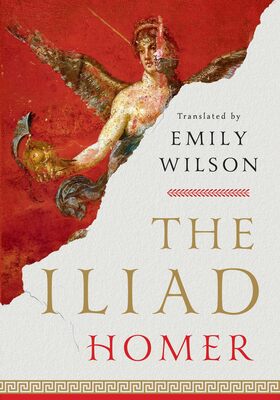
The Iliad
The Iliad
₹1,653.37 ₹1,837.08 Save: ₹183.71 (10%)
Go to cartISBN: 9781324076148
Bind: Paperback
Year: 2024
Pages: 848
Size: 5.5 x 8.5 Inch
Publisher: W. W. Norton & Company
Exclusive Distributors: Viva Books
Sales Territory: Indian Subcontinent
Reviews:
"Wilson’s style is like the proverbial mountain stream—clean and clear, and bubbling along at pace.… Wilson’s strong authorial voice and open and accessible style…make this volume the definitive Iliad for our times. Readable, relevant and from the heart, this is the Iliad we have all been waiting for, whether we knew it or not."
—Naoíse Mac Sweeney, Washington Post
"Wilson’s admirers hoped that her second Homeric translation would be as great an achievement as the first. What they might not have expected is that it would be better.… Emily Wilson has not only produced fresh and limpid new translations of two foundational ancient poems. She has also given a new generation of readers the tools to approach Homer, with comfort and confidence, for the very first time. For those who knew the poems already, she lets Homer speak to them in a new voice."
—Johanna Hanink, Slate
"Wilson’s deep love for and understanding of the Iliad—by her own admission, the greater of her Homeric loves—shine through every page of this superb translation. The completion of her verse Homer amounts to nothing less than the renewal of an English poetic tradition."
—Daniel Walden, Bulwark
"The experience of reading Homer must be refreshed from time to time with the blood of a new translation. In her version of The Iliad, [Emily] Wilson enlivens the epic with rich sanguinary nutrients.… The result is an Iliad of clarity and approachability, its violence rendered with brutal intimacy: Wilson’s translation is zippy, and it zips the reader to a place and time of alien savagery.… [T]he vigor of language and vision is undeniable."
—Atlantic
"There’s nothing stiff or cool about Emily Wilson’s stirring translation of The Iliad, which whips and crackles beneath the familiar meter of loose iambic pentameter. Wilson tells it all in plain English, to elegant effect.… [S]he deftly coaxes the original’s Dactylic hexameters into our own accentual tongue. We feel her joy, birthed by hard labor.… Wilson has pulled off a thrilling achievement, framing ancient questions in a fresh light."
—Hamilton Cain, Boston Globe
"Superb. Emily Wilson’s beautiful, fluent, memorable translation tells us once again that the Olympian gods and the would-be superhumans who want to emulate them are not yet dead in our world."
—Rowan Williams, New Statesman
"Wilson is at her best when writing of the battlefield.… [S]he has a knack for the consonantal sounds of warfare. Her opening description of Achilles’ anger, which will lead inexorably to more men’s weapons clanging against metal, terms it ‘cataclysmic wrath.’ Her priority is those iambic Shakespearean rhythms: the beat makes this the perfect translation to read aloud."
—Kate Maltby, Financial Times
"Wilson has again presented a Homer that sings, in sprightly iambic pentameter and pellucid language that avoids ponderosities like, well, ponderosities and pellucid.… The shortness of Wilson’s lines…abetted by her unfussy diction and lyricism, are easy on the reader’s eye and seem to help the mind grasp the breadth of Homer’s canvas at any given moment while still marveling at details.… A masterful, highly readable rendering of the Greek classic."
—Kirkus Reviews, starred review
"Seduce[s] with its crystalline clarity, elegance, sensuality, sometimes breathless pace and above all emotional clout."
—Edith Hall, Guardian
"Wilson achieves her register—at once plain spoken and slightly removed from everyday speech—partly by studiously avoiding contractions and allowing for metrically convenient epicisms like ‘mighty,’ mixed in with natural-seeming phrases like ‘only just heard the news about the war.’ The effect is not so much to bring the characters of the Iliad into the contemporary sphere, as to bring us into theirs.… Wilson has said that she is an Iliad person rather than an Odyssey one. And I have to say that for all that I enjoyed her Odyssey, I have been even more absorbed by her Iliad. It’s a poem you read with your heart in your throat."
—A. E. Stallings, Spectator
"The great virtue of this translation is its handling of action. In Wilson’s verse the acts of the poem stand out in brilliant, clear Mediterranean light.… The lengthy battle scenes in Homer that a reader might well dread—they shine.… Aeschylus claimed that his tragedies were ‘scraps from the great table of Homer,’ and with Wilson the great tragedy of the poem is felt afresh."
—John Byron Kuhner, National Review
"When she strikes the perfect balance between propulsive pacing, accessible language, and elevated sensibility, Wilson’s translation is easy to keep reading. When she does this while also listening to the way words sound, it’s even fun. Just as Keats, on first looking into Chapman’s Homer, felt a sense of amazed discovery, so too will readers of Wilson’s Iliad find fresh and absorbing clarity in this ancient poem."
—Zoe Guttenplan, Jacobin
"Wilson’s translation of Homeric Greek is always buoyant and expressive.… Wilson wants this version to be read aloud, and it would certainly be fun to perform. In Book 3, we meet Helen of Sparta, now Helen of Troy, ‘weaving a massive double-layered cloth / in dazzling colors, patterning upon it / the many troubles, tests, and tribulations / that Trojan horsemen and bronze-armored Greeks / suffered at Ares’ hands because of her.’ It is a gorgeous moment in both the poem and the translation: the beautiful Helen revealed by Homer as the creator of a war narrative, just like him. The contemporary reader sees a double reflection: Helen at her loom, weaving the same story Homer is telling, the same one Wilson is weaving."
—Natalie Haynes, New York Times Book Review
"Wilson’s translation is vivid, lucid, pacy. Avoiding cliché, she renders Homeric phrases into natural, modern English counterparts. At its best, the urgent, almost claustrophobic lub-dub of the pentameter keeps up the frenetic energy of close combat, all the while sounding like natural English.… For those yet to encounter this violent, charming, disturbing, beautiful poem, now is the time."
—Katherine Backler, Tablet
"Wilson’s spin on the battlefield saga centered on the Trojan conflict is refreshing and bold."
—Time
"In Wilson’s hands, the poem sings with the clash of bronze, the thundering of hooves, the savage holler of war-cries. Her use of iambic pentameter imbues it with irresistible pace and rhythm. It flows like music—exhilarating, tragic, beautiful and stirring.… Her use of language and imagery makes it a visual experience too; one of glittering metal and flame, full of searing light so that we feel entirely transported to an alien, ancient and terrifying world.… Running throughout is a humane, expressive connection of a truth we all know—the shattering inevitability of loss. Rediscovering it through Wilson’s eyes brought me to tears all over again."
—Jennifer Saint, i newspaper
"Wilson brings a rare combination of academic rigor and the lyricism of a born poet to one of Europe’s most important texts, making ancient battles vivid and visceral and the language of Homer sing like few translators before."
—Charlie Connelly, New European
"[Wilson] captures so brilliantly the fire and dread and bewilderment and rage of the poem. She wears her erudition beautifully: she matches it with such wit, precision and flair."
—Katherine Rundell
Description:
“Wilson’s Iliad is clear and brisk, its iambic pentameter a zone of enchantment.” —Ange Mlinko, London Review of Books
The greatest literary landmark of antiquity masterfully rendered by the most celebrated translator of our time.
When Emily Wilson’s translation of The Odyssey appeared in 2017—revealing the ancient poem in a contemporary idiom that was “fresh, unpretentious and lean” (Madeline Miller, Washington Post)—critics lauded it as “a revelation” (Susan Chira, New York Times) and “a cultural landmark” (Charlotte Higgins, Guardian) that would forever change how Homer is read in English. Now Wilson has returned with an equally revelatory translation of Homer’s other great epic—the most revered war poem of all time.
The Iliad roars with the clamor of arms, the bellowing boasts of victors, the fury and grief of loss, and the anguished cries of dying men. It sings, too, of the sublime magnitude of the world—the fierce beauty of nature and the gods’ grand schemes beyond the ken of mortals. In Wilson’s hands, this thrilling, magical, and often horrifying tale now gallops at a pace befitting its legendary battle scenes, in crisp but resonant language that evokes the poem’s deep pathos and reveals palpably real, even “complicated,” characters—both human and divine.
The culmination of a decade of intense engagement with antiquity’s most surpassingly beautiful and emotionally complex poetry, Wilson’s Iliad now gives us a complete Homer for our generation.
Contents:
Introduction
Translator’s Note
Maps
Greece and Western Anatolia
Central Greece
Journeys to Troy
The Troad Region
Theater of the Trojan War
The Iliad
Book 1: The Quarrel
Book 2: The Multitude
Book 3: Gifts of the Goddess
Book 4: First Blood
Book 5: Gods on the Battlefield
Book 6: The Price of Honor
Book 7: A Duel
Book 8: The Scales Tip
Book 9: The Embassy
Book 10: Espionage by Night
Book 11: Wounds
Book 12: The Wall
Book 13: The Waves
Book 14: An Afternoon Nap
Book 15: Fire at the Ships
Book 16: Love and Death
Book 17: Battle for a Dead Man
Book 18: Divine Armor
Book 19: A Meal Before Dying
Book 20: The Warrior’s Return
Book 21: The River
Book 22: A Race to Death
Book 23: Funeral Games
Book 24: A Time to Mourn
Notes
Genealogies
Glossary
Acknowledgments
About the Author:
HOMER’s identity is shrouded in mystery. Most scholars agree that an epic poet named Homer likely existed anywhere between 900 to 700 B.C.E. Legend, originating in antiquity, says that Homer was a blind bard from Ionia, but no account of Homer’s life can be verified. The Iliad and The Odyssey, the two epic poems attributed to Homer, which take place during the Trojan War and its aftermath, were derived from the oral storytelling tradition. Their method of composition—either by a single author or several bards working in tandem—remains unknown. The Homeric Poems are among the most significant narratives in the Greek and Western literary canon.
About the Editor:
Emily Wilson is a professor of classical studies at the University of Pennsylvania. She has been named a fellow of the American Academy in Rome, a Guggenheim Fellow, and a MacArthur Fellow. In addition to Homer’s Iliad and Odyssey, she has also published translations of Sophocles, Euripides, and Seneca. She lives in Philadelphia.
https://www.emilyrcwilson.com