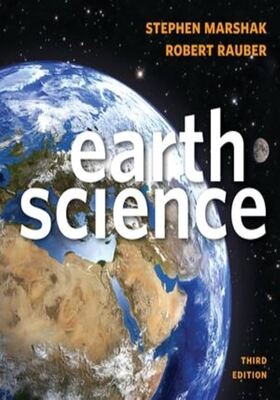
Earth Science, 3/e
Earth Science, 3/e
₹15,301.92 ₹17,002.13 Save: ₹1,700.21 (10%)
Go to cart-
Out of Stock
ISBN: 9781324071624
Bind: Paperback
Year: 2024
Pages: 984
Size: 9.75 x 10.75 Inch
Publisher: W. W. Norton & Company
Exclusive Distributors: Viva Books
Sales Territory: Indian Subcontinent
Description:
Introducing the exciting science of earth systems
Leading authors in their respective fields, Stephen Marshak (physical geology) and Robert Rauber (atmospheric science) bring decades of teaching and research experience to this remarkable textbook and media package. Earth Science, Third Edition, connects today’s learners with the science of earth systems. Accessible explanations, extraordinary visuals, and rich, versatile media resources help students appreciate how earth science matters in their lives, communities, and careers.
Contents:
Introduction: Welcome to Earth Science!
Part I. Our Dynamic Planet
Chapter 1. From the Big Bang to the Blue Marble
Chapter 2. The Way the Earth Works: Plate Tectonics
Chapter 3. What Is the Earth Made Of? Introducing Minerals and the Nature of Rock
Chapter 4. Up From the Inferno: Igneous Rocks and Volcanoes
Chapter 5. The Rest of the Rock Cycle: Sedimentary and Metamorphic Rocks
Chapter 6. Cracks, Crumples, and Crags: Geologic Structures and Mountain Building
Chapter 7. A Violent Pulse: Earthquakes
Chapter 8. Deep Time: How Old is Old?
Chapter 9. History Before History: A Biography of the Earth
Chapter 10. Riches in Rock: Energy and Mineral Resources
Part II. Ever-Changing Landscapes
Chapter 11. Shaping the Earth’s Surface: Landscapes, the Hydrologic Cycle, and Mass Wasting
Chapter 12. Freshwater: Streams, Lakes, and Groundwater
Chapter 13. Extreme Regions: Desert and Glacial Landscapes
Part III. Restless Seas
Chapter 14. Ocean Waters: The Blue of the Blue Planet
Chapter 15. Marine Geology: The Study of Ocean Basins and Coasts
Part IV. A Blanket of Gas: The Earth's Atmosphere
Chapter 16. The Air We Breathe: Introducing the Earth’s Atmosphere
Chapter 17. Winds of the World: Global and Local Wind Systems
Chapter 18. Danger in the Air: Stormy Weather
Chapter 19. Climate and Climate Change
Part V. Our Solar System…and Beyond
Chapter 20. Introducing Astronomy: Looking Beyond the Earth
Chapter 21. Our Neighborhood in Space: The Solar System
Chapter 22. The Sun, The Stars, and Deep Space
About the Authors:
Stephen Marshak is a Professor Emeritus of Geology at the University of Illinois, Urbana-Champaign, where he taught for 35 years. During this time, he also served as Head of the Department of Geology and as Director of the School of Earth, Society, & Environment. Steve holds an A.B. from Cornell University, an M.S. from the University of Arizona, and a Ph.D. from Columbia University, all in geology. His research interests in structural geology and tectonics have taken him in the field on several continents. Steve, a Fellow of the Geological Society of America, has won the highest teaching awards at both the college and campus levels at the University of Illinois, and has also received a Neil Miner Award from the National Association of Geoscience Teachers for “exceptional contributions to the stimulation of interest in the Earth Sciences.” His other books include Essentials of Geology, Earth Science, Natural Disasters, Laboratory Manual for Introductory Geology, Laboratory Manual for Earth Science, Earth Structure: An Introduction to Structural Geology and Tectonics, and Basic Methods of Structural Geology.
Robert Rauber is a Professor of Atmospheric Sciences at the University of Illinois, Urbana-Champaign, where he was Department Head for twelve years, and now serves as Director of the School of Earth, Society, & Environment. He holds a B.S. in Physics and a B.A. in English from the Pennsylvania State University, as well as an M.S. and Ph.D. in Atmospheric Sciences from Colorado State University. He oversees a research program that focuses on the development and behavior of storms, which takes him on some rather exciting flights into the midst of severe weather. Bob has won campus teaching awards, is a Fellow of the American Meteorological Society (AMS), and serves as the publication commissioner for the AMS. In addition to authoring many research papers, Bob has co-authored Earth Science, Laboratory Manual for Earth Science, Severe and Hazardous Weather: An Introduction to High Impact Meteorology, and a new book, Radar Meteorology, A First Course.