21st Century Astronomy 7e | Astronomy Textbook
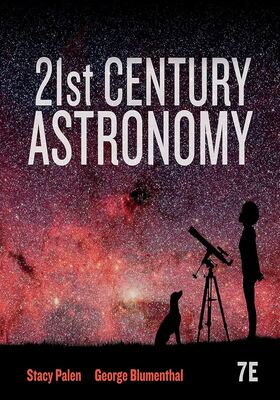
21st Century Astronomy, 7/e
₹14,259.27 ₹15,843.63 Save: ₹1,584.36 (10%)
Go to cartISBN: 9780393877021
Bind: Paperback
Year: 2022
Pages: 816
Size: 9.75 x 10.75 Inch
Publisher: W. W. Norton & Company
Exclusive Distributors: Viva Books
Sales Territory: Indian Subcontinent
Description:
Fostering scientific literacy, engaging every student.
Comprehensive and authoritative, 21st Century Astronomy fosters scientific literacy by offering carefully crafted activities that help students apply the process of science to astronomy, the news, and the world. The 21st Century learning package provides the most up-to-date astronomy research, engaging students as they prepare for lecture, perform in-class activities, and complete meaningful homework assignments—both in person and online. Lead author Stacy Palen draws on her experience teaching at an open enrollment university to build intentionality and transparency into every aspect of the learning package, giving activities a clear purpose and making them easy to execute without special equipment. Norton’s service supports every instructor, every step of the way.
Content:
PART I. INTRODUCTION TO ASTRONOMY
1. Thinking Like an Astronomer
2. Patterns in the Sky—Motions of Earth and the Moon
3. Motion of Astronomical Bodies
4. Gravity
5. Light
6. The Tools of the Astronomer
PART II. THE SOLAR SYSTEM
7. The Formation of Planetary Systems
8. The Terrestrial Planets and Earth’s Moon
9. Atmospheres of the Terrestrial Planets
10. Worlds of Gas and Liquid—The Giant Planets
11. Planetary Moons and Rings
12. Dwarf Planets and Small Solar System Bodies
PART III. STARS AND STELLAR EVOLUTION
13. Taking the Measure of Stars
14. Our Star: The Sun
15. The Interstellar Medium and Star Formation
16. Evolution of Low-Mass Stars
17. Evolution of High-Mass Stars
18. Relativity and Black Holes
PART IV. GALAXIES, THE UNIVERSE, AND COSMOLOGY
19. Galaxies
20. The Milky Way—A Normal Spiral Galaxy
21. The Expanding Universe
22. Cosmology
23. Large-Scale Structure in the Universe
24. Life
About the Authors:
Stacy Palen is an award-winning professor in the physics department at Weber State University. She received her BS in physics from Rutgers University and her PhD in physics from the University of Iowa. As a lecturer and postdoc at the University of Washington, she taught Introductory Astronomy more than 20 times over 4 years. Since joining Weber State, she has been very active in science outreach activities ranging from star parties to running the state Science Olympiad. Stacy does research in formal and informal astronomy education and the death of Sun-like stars. She spends much of her time thinking, teaching, and writing about the applications of science in everyday life. She then puts that science to use on her small farm in Ogden, Utah.
George Blumenthal is the director of the Center for Studies in Higher Education at the University of California, Berkeley. From 2006 to 2019 he was chancellor at the University of California, Santa Cruz. He joined the UC Santa Cruz faculty as a professor of astronomy and astrophysics in 1972. Chancellor Blumenthal received his BS degree from the University of Wisconsin–Milwaukee and his PhD in physics from the University of California, San Diego. As a theoretical astrophysicist, Blumenthal's research encompasses several broad areas, including the nature of the dark matter that constitutes most of the mass in the universe, the origin of galaxies and other large structures in the universe, the earliest moments in the universe, astrophysical radiation processes, and the structure of active galactic nuclei such as quasars.