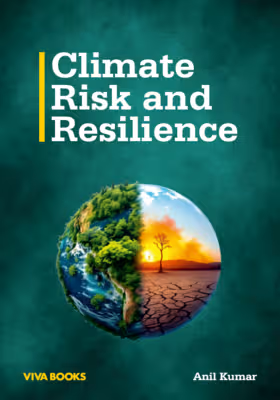
Climate Risk and Resilience
Climate Risk and Resilience
₹1,795.50 ₹1,995.00 Save: ₹199.50 (10%)
Go to cartISBN: 9789360339883
Bind: Paperback
Year: 2026
Pages: 848
Size: 6 x 9 Inch
Publisher: Viva Books Originals
Sales Territory: Worldwide
Description:
This is not a routine climate-change textbook. It is a practical companion and a call to action – resulting from decades of teaching, research and field engagement.
Across 12 crisp, comprehensive chapters, the book moves from climate science (energy balance, greenhouse effect, Keeling Curve, feedback loops) to risk assessment (hazard–exposure–vulnerability frameworks), and then to real-world resilience solutions. It covers decarbonization (renewables, nuclear, green hydrogen, energy efficiency), nature-based mitigation (forests, soils, agroforestry, mangroves), and the policy-to-action pipeline (Paris Agreement, COP process, Sendai Framework).
It then shifts to implementation: resilient infrastructure (roads, bridges, power, water), coastal protection and adaptation (wetlands, dunes, reefs, managed retreat), and community-led resilience with local knowledge and inclusive planning. The book also brings forward the human stakes – health impacts like heat stress, disease risks, and mental health – supported by grounded examples and actionable lessons.
Finally, it highlights the enablers: climate finance (green bonds, carbon markets, funds) and technology (AI, IoT, big data, blockchain), and closes with the most decisive lever – education and awareness that turns concern into capability.
Written for postgraduate students, researchers, policymakers and practitioners, this book answers one question with clarity: What can we do?
Target Audience:
The book serves postgraduate students, researchers, policymakers, and practitioners seeking practical strategies to address climate risks and build resilience.
Contents:
Foreword
Preface
Acknowledgements
Chapter 1. Climate Change: Science and Consequences • What Is Climate Change? The Science We Can’t Ignore • From Atmosphere to Climate Change: Tracing the Web of Interrelationships • The Atmosphere: The Foundation of Climate Systems • Weather: The Short-Term Face of the Atmosphere • Climate: Long-Term Atmospheric Patterns • The Greenhouse Effect • How the Greenhouse Effect Works • Greenhouse Gas Emissions – Natural vs Human-Caused • Human Influence on the Greenhouse Effect • Consequences of the Enhanced Greenhouse Effect • From Global to Grassroots: Tracking Human-Caused Emissions • How Earth Is Warming? • The Keeling Curve: Tracking the Pulse of Our Planet • Carbon Cycle Disruptions • Feedback Loops and Climate Sensitivity • Key Feedback Mechanisms in Climate Change • Higher Climate Sensitivity Due to Positive Feedbacks • Uncertainty in Climate Models – Challenge of Predicting the Reactions • The Central Lesson: A Reactive Planet • Examples of Potential Impacts of Climate Feedback Loops • A Snapshot of Responsibility: Who Emits the Greenhouse Gases? • Earth’s Climate Thermostat: Balance, Imbalance, and Our Future Paths • Earth’s Energy Balance: The Planetary Budget Climate Risk and Resilience • Radiative Forcing • How IPCC AR5 Used RCPs for Climate Prediction (Projections) • IPCC AR6 Used Integration of SSPs AND RCPs for Future Climate Projections • Extreme Weather Events: A Planet Pushed to the Extreme • Regional Climate Impacts • Asia: Where Ancient Rhythms Are Breaking • Africa: A Continent in the Grips of Climate Stress • Why Vulnerability Runs Deep: The Underlying Truths • A Moral and Practical Imperative • Climate Change in India • The Monsoon Is Becoming Less Predictable and More Dangerous • Heat: The Slow Disaster That Strikes First • The Himalayas: Melting Ice, Unstable Slopes, Sudden Floods • Coasts and Cyclones: Higher Water, Higher Damage • New Climate Mix for India • Impacts on Developed Nations • Wildfires: When ‘Fire Season’ Becomes a Long Season • Drought and Water Scarcity • Heatwaves • Infrastructure Stress • Economic and Social Impacts • Impact on Agriculture and Food Security • Migration and Displacement • Ecosystems and Biodiversity Loss • Impact on Ecosystems • Loss of Biodiversity in a Changing Climate • Ecosystem Services at Risk • Urgency of Climate Action • Tipping Points in the Climate System • Summary • References • Practice Questions
Chapter 2. Climate Risk Assessment and Management • Introduction • Understanding Climate Risk • Meaning of Climate Risk • Difference between Climate Hazard, Exposure, Vulnerability, and Risk • Climate Risks vs Traditional Environmental Risks • Types of Climate Risks • Climate Hazards and Impact Pathways • Slow-Onset vs Extreme Events • Cascading and Compound Risks • Sectoral Impact Pathways • Vulnerability and Exposure Analysis • Social, Economic, and Environmental Vulnerability • Differential Impacts on Regions, Communities, and Sectors • Role of Poverty, Gender, Geography, and Governance • Exposure Mapping for People, Assets, and Ecosystems • Climate Risk Assessment Frameworks • The IPCC Risk Framework • Hazard–Exposure–Vulnerability (HEV) Model • Qualitative vs Quantitative Risk Assessment • Scenario-Based Risk Analysis • Using RCPs and SSPs in Climate Risk Assessment • Tools and Methods for Climate Risk Assessment • Climate Models and Downscaling Techniques • GIS-Based Risk Mapping • Vulnerability Indices and Composite Indicators • Economic Risk Assessment and Damage Functions • Remote Sensing and Climate Data Platforms • Sector-Specific Climate Risk Assessment • Agriculture and Food Security • Water Resources and Hydrological Risks • Urban and Infrastructure Systems • Energy Systems and Supply Chains • Coastal and Marine Systems • Public Health Risks • Climate Risk Management Approaches • Risk Avoidance, Risk Reduction, Risk Transfer, and Risk Acceptance • Structural and Non-Structural Measures • Nature-Based Solutions for Risk Reduction • Climate-Resilient Infrastructure Planning • Risk-Informed Land-Use Planning • Summary • Practice Questions
Chapter 3. Decarbonization – Climate Resilient Future • Introduction • Overview of Renewable Energy Sources • Energy Efficiency in the Clean Energy Transition • Case Studies: Global Renewable Energy Initiatives • Global Renewable Energy Success Stories • India’s Renewable Energy Targets and Progress • Lessons Learned and Best Practices • Policies for Scaling Up Energy Efficiency Measures • Global Energy Efficiency Policies • India’s Energy Efficiency Policies • Challenges and Opportunities in Scaling Up Energy Efficiency • Summary • References • Practice Questions
Chapter 4. Land Use and Nature-Based Solutions – Carbon Sequestration • Introduction • Overview of Sustainable Agricultural Practices • Soil Carbon Sequestration • Climate-Smart Agriculture (CSA) • Reforestation and Afforestation • Importance of Forests in Carbon Sequestration • Reforestation • Afforestation • The Role of Mangroves in Carbon Sequestration • Case Studies in Reforestation and Afforestation • Brazil’s Reforestation Efforts • India’s Afforestation and Reforestation Programmes • Nature-Based Solutions (NbS) for Carbon Sequestration and Climate Mitigation • Summary • References • Practice Questions
Chapter 5. Low-Carbon Development – Policy and Governance • Introduction • International Cooperation on Low-Carbon Development • Global Climate Agreements • International Collaboration on Climate Financing • Challenges and Opportunities in Global Climate Cooperation • Carbon Pricing and Taxes • Carbon Pricing as a Tool for Emissions Reduction • Carbon Markets and Carbon Credits • The Role of Carbon Pricing in Promoting Innovation • Global Good Practices of Carbon Reduction • EU’s Emissions Trading System (ETS) • California’s Cap-and-Trade Programme • Carbon Border Adjustment Mechanism (CBAM) • Other Global Carbon Pricing Initiatives • Challenges in Global Climate Governance • Indian Governance on Climate Change • India’s International Commitments on Climate Change • National Frameworks and Policies • Conclusion • Summary • References • Practice Questions
Chapter 6. Climate Resilient Infrastructure • Introduction • Overview of Climate-Resilient Infrastructure • Resilience in Transport Infrastructure • Water Infrastructure Resilience • Resilience in Energy Infrastructure • Case Studies: Climate-Resilient Infrastructure • Japan’s Earthquake-Resistant Structures • India’s Flood-Resilient Roads • Case Study: Kerala’s Post-Flood Infrastructure Recovery • Global Case Studies on Resilient Energy Infrastructure • The Netherlands’ Flood Control Systems – Resilient Water Infrastructure • Summary • References • Practice Questions
Chapter 7. Coastal and Marine Resilience • Introduction • Overview of Coastal Vulnerabilities • Coastal Defences and Hard Infrastructure • Natural Barriers and Ecosystem-Based Approaches • Ecosystem Restoration and Managed Retreat • Case Studies: Coastal and Marine Adaptation • The Netherlands’ Coastal Defences • India’s Mangrove Restoration in the Sundarbans – Nature’s First Line of Defence • Global Case Studies in Coastal and Marine Adaptation • Summary • References • Practice Questions
Chapter 8. Community-Based Adaptation for Resilience • Introduction • Overview of Community-Based Adaptation (CBA) • Climate-Smart Agriculture (CSA) • Disaster Preparedness and Risk Reduction • Collaborative Planning and Knowledge Sharing • Case Studies: Community Adaptation Projects • Community Adaptation Projects in Bangladesh • Community Adaptation in Indian Tribal Communities • Global Examples of Community-Based Adaptation • Summary • References • Practice Questions
Chapter 9. Building Resilience through Health and Well-being • Introduction • Climate Change and Public Health • Heat Stress and Its Effects • Waterborne Diseases • Vector-Borne Diseases • Climate-Resilient Health Systems and the Role of Public Health • Building Climate-Resilient Health Systems • Public Health Interventions in Climate Resilience • Mental Health and Climate Change • Resilience Engineering for Climate-Resilient Health Systems • Case Studies: Climate-Resilient Health Initiatives • Heat Action Plans in Indian Cities • Health Resilience in Vulnerable Regions • Global Heat Resilience Initiatives • Summary • References • Practice Questions
Chapter 10. Climate Resilience Financing • Introduction • Global Frameworks for Climate Resilience Financing • India’s Framework on Climate Resilience Financing • Instruments and Mechanisms of Climate Finance • Challenges in Climate Resilience Financing • Opportunities and Innovations • Case Studies • Financing a Resilient Future • Summary • References • Practice Questions
Chapter 11. Technology and Innovation for Climate Solutions • Introduction • The Role of Technology in Addressing Climate Challenges • Energy Storage Technologies • Grid Flexibility • Climate-Smart Agriculture (CSA) • Key Objectives of Climate-Smart Agriculture • Precision Agriculture: Optimizing Resource Use with Technology • Sustainable Farming Practices • The Role of Climate-Smart Agriculture (CSA) in Climate Mitigation and Adaptation • Innovations for Climate Adaptation and Risk Prediction • Artificial Intelligence (AI) in Climate Solutions • Internet of Things (IoT) in Climate Adaptation • Big Data and Climate Risk Prediction • Blockchain for Climate Solutions • Case Studies: Tech-Driven Solutions in Climate Adaptation and Mitigation • Smart Cities for Climate Resilience • Tech-Driven Agriculture Projects in Africa and India • Renewable Energy Innovation Hubs • Summary • References • Practice Questions
Chapter 12. Education and Awareness • Raising Public Awareness – Climate Education • The Role of Education in Climate Action • Incorporating Climate Education in Schools • Higher Education and Climate Change • Fostering Informed Decision-Making • Public Engagement in Climate Awareness • Climate Resilience in Policy and Decision-Making • Green Marketing and Public Outreach • Case Studies: Global Climate Education Initiatives and India’s Youth- Led Climate Awareness Programmes • Global Climate Education Initiatives • India’s Youth-Led Climate Awareness Programmes • Local and Regional Climate Education Initiatives in Developing Countries • Pacific Islands Climate Resilience Campaigns • Summary • References • Practice Questions
About the Author:
Prof. Anil Kumar is Professor of Practice at NITTTR, Kolkata (Ministry of Education, GoI), working at the intersection of climate science, disaster risk management, and resilience planning. Trained in civil engineering (Gold Medallist), in Hydrology (IIT Roorkee) along with a PhD in Environmental Science and advanced Master’s degrees in Disaster Mitigation, as well as Ecology & Environment, he focuses on turning climate evidence into decisions institutions can implement.
Over four decades, he has contributed through academic leadership, advisory roles, and development programmes – supporting risk assessment, capacity building, and resilience frameworks for heat, flood, and water-security challenges. He has authored books and training resources on Disaster Management, Climate Change, Water Security, and Ecosystem Resilience.
His contributions have been recognized through awards and fellowships, including the ISTE Fellowship (2024) and sustainability-focused honours (including a National Sustainability Award in 2025).
Deeply influenced by Bharatiya thought and culture, he continues to work with organizations like Sewa Bharati, Vigyan Bharati, Bharat Vikas Parishad and Pragya Parishad, inspiring efforts towards an environmentally sustainable and culturally harmonious Bharat.