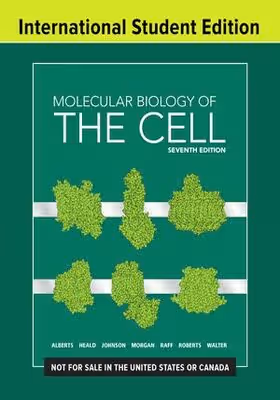
Molecular Biology of the Cell, 7/e
Molecular Biology of the Cell, 7/e
(International Student Edition)
₹11,058.53 ₹12,287.25 Save: ₹1,228.73 (10%)
Go to cartISBN: 9780393884852
Bind: Paperback
Year: 2022
Pages: 1552
Size: 8.5 x 11 Inch
Publisher: W. W. Norton & Company
Exclusive Distributors: Viva Books
Sales Territory: Indian Subcontinent
Price: $129
Description:
For more than four decades, Molecular Biology of the Cell has distilled the vast amount of scientific knowledge to illuminate basic principles, enduring concepts and cutting-edge research. The Seventh Edition has been extensively revised and updated with the latest research, and has been thoroughly vetted by experts and instructors.
Target Audience:
Students of Cell biology and Biosciences.
Contents:
Part I: Introduction to the Cell
Chapter 1. Cells, Genomes, and the Diversity of Life
Chapter 2. Cell Chemistry and Bioenergetics
Chapter 3. Proteins
Part II: Basic Genetic Mechanisms
Chapter 4. DNA, Chromosomes, and Genomes
Chapter 5. DNA Replication, Repair, and Recombination
Chapter 6. How Cells Read the Genome: From DNA to Protein
Chapter 7. Control of Gene Expression
Part III: Ways of Working with Cells
Chapter 8. Analyzing Cells, Molecules, and Systems
Chapter 9. Visualizing Cells and Their Molecules
Part IV: Internal Organization of the Cell
Chapter 10. Membrane Structure
Chapter 11. Small-Molecules Transport and Electrical Properties of Membranes
Chapter 12. Intracellular Organization and Protein Sorting
Chapter 13. Intracellular Membrane Traffic
Chapter 14. Energy Conversion and Metabolic Compartmentation: Mitochondria and Chloroplasts
Chapter 15. Cell Signaling
Chapter 16. The Cytoskeleton
Chapter 17. The Cell Cycle
Chapter 18. Cell Death
Part V: Cells in Their Social Context
Chapter 19. Cell Junctions and the Extracellular Matrix
Chapter 20. Cancer
Chapter 21. Development of Multicellular Organisms
Chapter 22. Stem Cells in Tissue Homeostatis and Regeneration
Chapter 23. Pathogens and Infection
Chapter 24. The Innate and Adaptive Immune Systems
About the Authors:
Bruce Alberts received his PhD from Harvard University and is the Chancellor’s Leadership Chair in Biochemistry and Biophysics for Science and Education, University of California, San Francisco. He was the editor in chief of Science magazine from 2008 until 2013, and for 12 years he served as president of the U.S. National Academy of Sciences (1993–2005).
Rebecca Heald is an American professor of cell and developmental biology. She is currently a professor in the Department of Molecular and Cell Biology at the University of California, Berkeley. In May 2019, she was elected to the National Academy of Sciences.
Alexander Johnson received his PhD from Harvard University and is a professor of microbiology and immunology at the University of California, San Francisco. He is a member of the National Academy of Sciences.
David Morgan received his PhD from the University of California, San Francisco, and is a professor in the Department of Physiology as well as the vice dean for research for the School of Medicine. Dave is a fellow of the Royal Society of London.
Martin Raff received his MD from McGill University and is emeritus professor of biology at the Medical Research Council Laboratory for Molecular Cell Biology at University College London. He is a foreign member of the National Academy of Sciences.
Keith Roberts received his PhD from the University of Cambridge and was deputy director of the John Innes Centre, Norwich. He is emeritus professor at the University of East Anglia. Keith was recipient of the Order of British Empire for his service to sciences.
Peter Walter received his PhD from the Rockefeller University in New York, is a professor in the Department of Biochemistry and Biophysics at the University of California, San Francisco, and is an investigator at the Howard Hughes Medical Institute. He is a member of the National Academy of Sciences.