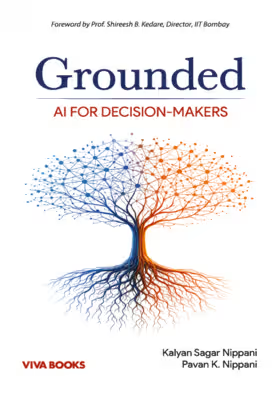
Grounded: AI for Decision-Makers
Grounded: AI for Decision-Makers
₹535.50 ₹595.00 Save: ₹59.50 (10%)
Go to cartISBN: 9788169782005
Bind: Paperback
Year: 2026
Pages: 172
Size: 6 x 9 Inch
Publisher: Viva Books Originals
Sales Territory: Worldwide
Foreword by Prof. Shireesh B. Kedare, Director, IIT Bombay
Description:
Al is already changing how organizations make decisions, serve citizens and customers, manage risk, build products, and compete. In spite of it being common knowledge that Al will reward the prepared, many teams remain stuck in pilots, unsure how to separate real value from noise. Written for leaders, professionals, and policymakers who need to understand this technology beyond buzzwords and hype, Grounded gives readers a practical foundation in the language, logic, and trade-offs of modern Al. It explains machine learning, generative AI, neural networks, grounding, retrieval augmented generation, Al agents, responsible Al, policy, risk, and implementation in clear, accessible language. The goal is to help decision-makers ask sharper questions: What problem are we solving? Is the data ready? What risks are we accepting? How will we measure success? What should remain human-led?
Grounded also explores Al’s impact across government, education, healthcare, agriculture, manufacturing, telecommunications, climate, and employment, with a special focus on India and developing nations. It examines both sides of the Al opportunity: productivity, access, innovation, and public-service transformation on one side; bias, privacy, misinformation, security, accountability, and job disruption on the other. The book closes with a practical implementation framework for organizations moving from curiosity to action: discovery, data strategy, model selection, prototyping, piloting, change management, governance, operations, audit, and continuous improvement.
Written from the combined perspective of public-sector leadership and enterprise technology implementation, Grounded helps readers cut through the noise, spot the risks, identify the opportunities, and make better
decisions in an AI-driven world.
Target Audience:
The book is written for leaders, professionals, and policymakers who need to understand this technology beyond buzzwords and hype, it gives readers a practical foundation in the language, logic, and trade-offs of modern AI.
Contents:
Foreword
Preface
Acknowledgments
Chapter 1. Foundations: Concepts and History • Creating Intelligent Machines • Artificial Intelligence (AI): The 4th Revolution • Human Desire for Automata • AI—Fiction to Fact: Man Friday or Ultron? • Evolution of Artificial Intelligence: From Rules to Creativity • Early AI • The Birth of Machine Learning: Teaching Machines to Learn • Deep Learning: The Age of Neural Networks • Artificial Neural Networks • Components of a Machine Learning System • Generative AI: Machines That Create • Agentic AI: AI That Can Act • Model Context Protocol (MCP) • Agentic Orchestration • The Future Autonomous Agents: A New Business Model • Artificial General Intelligence (AGI) • AI Taxonomy: How It Learns, How It Reasons, Data Modality • Classifying AI by How It Reasons • Classifying AI by How It Learns • Classifying by Data Modality • The AI Ecosystem • A Few Considerations • Deterministic Versus Non-Deterministic Responses • Grounding • Scaling • The 5 Trillion Dollar Surprise: Why Graphics Processing Units Matter • Data Processing Units (DPUs) and Neural Processing Units (NPUs)
Chapter 2. A Deeper Dive into How Machines Learn • Supervised Learning • Gradient Descent: Getting to the Right Fit • Considerations in Gradient Descent • Bias and Variance Tradeoff • Regularization (Model Complexity Control) • Hyperparameters: How to Control Model Learning • Model Testing: How Do We Know That the Model Is Good Enough • Training, Testing and Cross-Validation Datasets • The Learning Curve • Why We Need Neural Networks, How They Work • Forward and Backpropagation • Anatomy of a Generative AI System • Data and Signals • The Data Pipeline • Embeddings and the Vector Store/Index • Retrieval Augmented Generation (RAG) • Context Window and Tokens • The Model • Orchestration or Agentic Layer • Scope of Orchestration Layer • API Layer • Observability/Monitoring and FinOps • The User Experience • Model Distillation
Chapter 3. Risks, Ethics and Policy • Ethical Principles of AI • A Case of Dr Jekyll and Mr Hyde: The Minimax Way • AI Risks • Biases • Data Privacy Risks • Adversarial Attacks • Entropy and Model Drift • Hallucinations • Homogeneity Problem in LLMs • Sycophancy • Model Collapse or Model Autophagy Disorder (MAD) • Alignment
Chapter 4. Governance and Policy • Policy • Why Businesses Need New AI Policy • Responsible AI • Explainability and Fairness • Transparency • Inclusiveness • Privacy and Security • Safety and Reliability • Regulatory Landscape • EU AI Act • NIST AI 100-1 • ISO/IEC—JTC/SC 42 AI Standards
Chapter 5. Case Studies and Sector Deep Dives • Government/Public Sector: Developing Nations—AI’s Sectoral Impact • Education • Healthcare Sector • Agriculture Sector • Manufacturing Sector and Productivity • Retail Sector • Financial Services Sector • Employment Sector • Business and Industry • Energy, Power and Gas • Climate Analysis, Environment and Conservation • Telecommunication Sector • India Deep Dive (UPI, Ayushman, Bhashini): Lessons and Transferability • India: A Global Leader and Trendsetter in AI • Ayushman Bharat Digital Mission • UPI: Revolutionizing the Financial Landscape of India • Bhashini: Transcending Language Barriers • Haqdarshak: Empowerment Through Information • Symbiosis and Synergy: The Traditional and the Modern
Chapter 6. Implementation Framework • Phase 0: Discovery and Strategy • Problem Identification and Articulation • Pain-Point and Root-Cause Analysis • Document Analysis • SWOT and SOAR Analysis • Defining Success Milestones and Timelines • Phase 1: Planning and Data Strategy • From As-Is to To-Be Analysis/Gap Analysis • Data Dynamics and Quality • Project Road Map • Phase 2: Model Selection and Prototyping • AI Model Development/Selection • Training Testing and Validating the Model • Comparative Analysis (Learning from Both Success and Failure Stories) • Phase 3: Pilot and Change Management • Creating “Ownership” of the Transformational Project • Creating Change Champions and Change Agents • Force Field and Sentiment Analysis • Employee Engagement Surveys • Workforce Engagement through Brainstorming, Townhall Meetings, etc. • Stakeholder Engagement: Unions and Partner Ecosystem • Collaborative Workshops, Focus Groups and Quality Circles • Stakeholder Engagement: Change Impact Assessment (CIA) • Scenario Planning • Phase 4: Productionalization and MLOps • Integration of the AI Model into the Existing System • Phase 5: Operate and Audit • Observability and FinOps • The Evaluation Loop • Pre-response Evaluation • Post-response Evaluation • Corrective Actions • Longitudinal Study • Post- Implementation Reviews, AI Audit and Updating Datasets
Chapter 7. The Road Ahead • AI and Developing Nations: Challenges • UNCTAD Debate: From Free Markets to Favelas • United Nations: Sustainable Development Goals (SDGs) • Strategies for Bridging the Gaps and Creating Opportunities • The Golden Niche • Economic and Societal Impact (Jobs, Inequality and Regulation) • The Progressive “AI-fication” Journey • Conclusion: Stay Grounded Across Impact lanes • Productivity and Power • Work and
Wage Reorganization • Trust, Truth and Integrity • Safety and Security Risks • Compute, Energy and Supply Chains • Governance and Accountability • Capability Transformation and Adaptation
About the Authors:
Dr. Kalyan Sagar Nippani qualified through All India Civil Services Examination and joined the Higher Civil Services in the Central Government. He is presently Director — Human Resources (HR) of BSNL and MTNL. Dr. Nippani is the author of five bestselling books: What My Cat Taught Me & My MBA Didn’t: Management Demystified for Everyday Excellence; The 7th Sense: Primordial Strategies for Personal & Corporate Success; Scientific Laws of
Leadership: Achieving Success and Reaching Goals; From Kindergarten to Corporation: Leadership Lessons That Children Can Teach Us and Digital India: Governance Transformation. These received wide and exceptional reviews in leading national dailies and magazines. Dr. Nippani has a PG Diploma in Personnel Management, an MBA in Finance, an MBA in Marketing Management and a PG Diploma in Business Management. He is a motivational speaker, a life-skills coach and honorary guest faculty to many organizations in Government and the corporate sector. He can be reached at: sagar_kn@rediffmail.com
Pavan K. Nippani is a business and technology leader with more than 24 years of experience, including nearly two decades at Microsoft across engineering, consulting, strategy, and senior go-to-market leadership. His work focuses on helping public-sector organizations modernize with cloud, data, and Al. He has worked with government leaders on modernization programs, Al strategy, executive briefings, and Al hackathons that move teams from ideas to working prototypes.