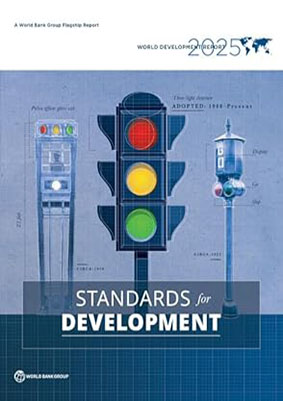
Standards for Development: World Development Report 2025
Standards for Development: World Development Report 2025
₹4,661.10 ₹5,179.00 Save: ₹517.90 (10%)
Go to cartISBN: 9781464822759
Bind: PB
Year: 2025
Pages: 374
Size: 8 x 10.5 Inch
Publisher: The World Bank
Sales Territory: Indian Subcontinent
Description:
Standards make everyday life run smoothly. You rarely notice them: the credit card that works in any corner of the world, the Wi-Fi signal that connects a remote village to the cloud, or the vaccine vial that fits syringes from Dakar to Delhi. When standards work, they build trust. They free people and firms to focus on creating, trading, and innovating, confident that the systems around them will hold. When standards fail, the effects are immediate and draining. Payments are declined, signals drop, vaccines spoil—and instead of being productive, people spend their energy just meeting their basic needs.
Standards, in short, are the hidden infrastructure of modern economies—and they have never been more important. Developing countries today must contend with a thicket of increasingly stringent international standards, a product of globalization and rapid technological change. Using standards—and shaping them—is now a prerequisite for export growth, technology diffusion, and the efficient delivery of public services. Yet standards are too often overlooked by policy makers, especially in developing countries.
World Development Report 2025 provides the most comprehensive assessment of the global landscape of standards today and how they can be used to accelerate economic development. It offers a practical framework for countries at all stages of development. Countries at the earliest stage should adapt international standards to suit local conditions when needed, whereas at more advanced stages, they should aim to align domestic markets with international standards. Meanwhile, all countries should author international standards in priority areas.
Contents:
Chaper 1. A History of Standards
Chapter 1 examines the history of standards, from ancient systems of measurement to modern digital protocols, demonstrating how standards have served not only as technical tools, but also as means of coordination, authority, and exchange, supporting the governance of empires, the expansion of trade networks, and the advancement of science and industry. Developments in these areas have significantly contributed to nation building, market integration, and international cooperation, acting as catalysts for economic transformation.
Chapter 2. Using Standards as a Catalyst for Development
Chapter 2 offers guidance on the different ways that both voluntary and mandatory standards can serve as tools of public policy, highlighting how standards differ from regulations and how they complement other instruments such as market-based policies. It also presents a conceptual framework showing how low- and middle-income countries can move toward higher standards for quality, adapting international standards to local capacity when necessary, while gradually raising the ambition of their standards and their ability to meet those standards.
Chapter 3. Reaching the Full Potential of Standards with Quality Infrastructure
Chapter 3 explains how countries can increase their ability to comply with standards by developing effective quality infrastructure. It discusses how to strengthen institutions, sequence reforms, and allocate roles between the government and the private sector.
Chapter 4. Standards for a Better Economy
Chapter 4 discusses how adopting voluntary standards raises the quality of a country’s products and services and how international trade accelerates the diffusion of such standards. It documents the proliferation of increasingly complex and stringent standards and regulations over the past two decades and explains how low- and middle-income countries acquire tacit knowledge through foreign direct investment. The chapter also highlights the growing role of technology standards and how these countries can strategically leverage them.
Chapter 5. Standards for Better Human Capital
Chapter 5 focuses on standards in health care and education, especially during early childhood, to improve lifelong outcomes. It shows how process standards, such as procedural checklists and standardized treatments, enhance the quality of health care, whereas standards regarding teacher qualifications, attendance, and pedagogy increase educational quality. Measurement standards are also key to driving educational reform and improving learning outcomes.
Chapter 6. Standards for a Better Environment
Chapter 6 examines how countries can use environmental standards to support green growth by reducing pollution and fostering adaptation to climate change, while balancing the economic costs and benefits of such standards.
Chapter 7. Standards for Better Governance
Chapter 7 discusses how governance standards in three core functions—personnel, payments, and procurement—enable governments to implement policies effectively and deliver public goods and services. Leveraging such standards strengthens institutional capacity and ensures greater efficiency, fairness, and accountability.
Chapter 8. Using Standards to Shape Development and Manage Global Challenges
Chapter 8 provides a set of recommendations for how policy makers in low- and middle-income countries—and elsewhere—can use standards most effectively for development. Policy makers in low- and middle-income countries should be sure to use standards as a springboard for development, not a straitjacket. Regarding the global community, more effort is needed to ensure that international standards align with the realities in low- and middle-income countries from the beginning of the development process.