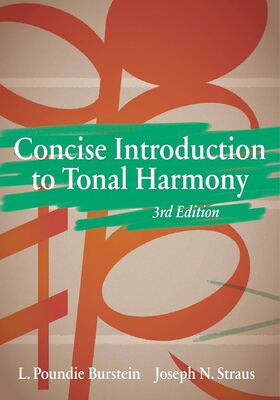
Concise Introduction to Tonal Harmony, 3/e
Concise Introduction to Tonal Harmony, 3/e
₹12,155.85 ₹13,506.50 Save: ₹1,350.65 (10%)
Go to cartISBN: 9781324100737
Bind: Hardbound
Year: 2025
Pages: 528
Size: 8.25 x 10.25 Inch
Publisher: W. W. Norton & Company
Exclusive Distributors: Viva Books
Sales Territory: Indian Subcontinent
Description:
A guidebook to the most important things your students need to know
Successfully used by thousands of students at hundreds of schools, Concise Introduction to Tonal Harmony represents a tested, concise approach to the tonal harmony textbook. The text introduces all the topics typically covered in the undergraduate theory sequence—fundamentals, diatonic and chromatic harmony, form, and post-tonal theory—but the focus is on carefully annotated notated musical examples rather than lengthy prose explanations of rules and exceptions, and engaging online tools help students build skills. This is a text your students will be able to read and comprehend, freeing up class time for enriching discussions and activities.
Burstein and Straus—both experienced classroom teachers—illustrate concepts using a repertoire of music from a diverse range of composers in the Western tradition. The Third Edition increases the diversity of the selections with new pieces by J. Rosamond Johnson, Eva Jessye, Tania Léon, and more historically marginalized composers. Additionally, you can more easily incorporate jazz and popular music into your course with new teaching resources and worksheets on jazz and popular music topics.
A concise text that students will read and remember
Each chapter is just a few pages long and isolates a particular harmony and the voice-leading issues associated with it, primarily using annotated notated musical examples to illustrate concepts. Instead of lengthy prose explanations that might bog them down, students are taught important concepts in the context of notated musical examples and guided through common errors and how to avoid them.
Contents:
Part 1. Fundamentals
Chapter 0. Notation of Pitch and Rhythm
Chapter 1. Scales
Chapter 2. Intervals
Chapter 3. Triads and Seventh Chords
Part 2. Overview of Harmony and Voice Leading
Chapter 4. Four-Part Harmony
Chapter 5. Voice Leading
Chapter 6. Harmonic Progressions
Chapter 7. Melodic Elaboration
Chapter 8. Species Counterpoint
Part 3. Diatonic Harmony
Chapter 9. I and V
Chapter 10. The Dominant Seventh Chord: V7
Chapter 11. I6 and V6
Chapter 12. V65 and V42
Chapter 13. V43 and viio6
Chapter 14. Approaching the Dominant: IV, ii6, and ii65
Chapter 15. Embellishing V: Cadential 6/4
Chapter 16. Leading to Tonic: IV
Chapter 17. The Leading-Tone Seventh Chord: viio7 and vii/o7
Chapter 18. Approaching V: IV6, ii, ii7, and IV7
Chapter 19. Multiple Functions: VI
Chapter 20. Voice Leading with Embellishing Tones
Chapter 21. III and VII
Chapter 22. Sequences
Chapter 23. Other 6/4 Chords
Chapter 24. Other Embellishing Chords
Part 4. Chromatic Harmony
Chapter 25. Applied Dominants of V
Chapter 26. Other Applied Chords
Chapter 27. Modulation to the Dominant Key
Chapter 28. Modulation to Closely Related Keys
Chapter 29. Modal Mixture
Chapter 30. bII6: The Neapolitan Sixth
Chapter 31. Augmented Sixth Chords
Chapter 32. Other Chromatically Altered Chords
Chapter 33. Chromatic Sequences
Chapter 34. Chromatic Modulation
Part 5. Form
Chapter 35. Sentences and Other Phrase Types
Chapter 36. Periods and Other Phrase Pairs
Chapter 37. Binary Form
Chapter 38. Ternary and Rondo Forms
Chapter 39. Sonata Form
Part 6. Post-Tonal Theory
Chapter 40. Collections and Scales I: Diatonic and Pentatonic
Chapter 41. Collections and Scales II: Octatonic, Hexatonic, and Whole-Tone
Chapter 42. Triadic Post-Tonality
Chapter 43. Intervals
Chapter 44. Pitch-Class Sets: Trichords
Chapter 45. Inversional Symmetry
Chapter 46. Twelve-Tone Serialism
Chapter 47. Form
About the Authors:
L. Poundie Burstein is Professor of Music Theory at Hunter College and the Graduate Center of the City University of New York. He has taught at Mannes College, Queens College, and Columbia University. He has written many articles on tonal music and performed extensively as a pianist for comedy improvisation groups. He is President of the Society for Music Theory.
Joseph Straus is Distinguished Professor of Music Theory at the Graduate Center of the City University of New York. He has taught at the University of Wisconsin–Madison and Queens College and has held visiting positions at the University of Chicago, Harvard University, Yale University, Princeton University, and New York University. He has many written articles and books on twentieth-century music and is the author of several textbooks, including Concise Introduction to Tonal Harmony, Elements of Music, and Introduction to Post-Tonal Theory. He is a former President of the Society for Music Theory.