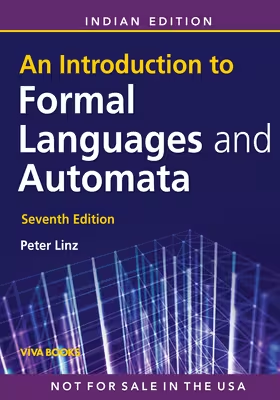
An Introduction to Formal Languages and Automata, 7/e
An Introduction to Formal Languages and Automata, 7/e
₹895.50 ₹995.00 Save: ₹99.50 (10%)
Go to cartISBN: 9789378681448
Bind: Paperback
Year: 2026
Pages: 572
Size: 6.75 x 9.5 Inch
Publisher: Jones & Bartlett Learning
Published in India by: Viva Books
Sales Territory: Indian Subcontinent
Description:
An Introduction to Formal Languages and Automata, Seventh Edition is designed for an introductory course on formal languages, automata, computability, and related matters forming what is known as the theory of computation. The text takes a problem-solving approach, in which students’ abilities are tested at various levels.The Seventh Edition familiarizes students with the foundations and principles of computer science, teaches material useful in subsequent courses, and strengthens students’ ability to carry out formal and rigorous mathematical arguments.
To present ideas clearly and to give students insight into the material, the text stresses intuitive motivation and illustration of ideas through examples. Where there is a choice, the author prefers arguments that are easily grasped to those that are concise and elegant but difficult in concept.
New & Key Features of the Seventh Edition:
- New Introductory Exercises help to bridge concepts to more difficult exercises
- Chapters 1-14 of the sixth edition, with the new exercises, are now reorganized as Part I: Theory
- NEW - Three NEW chapters on parsing are included in a new section, Part 2: Applications, and focus on how to apply theory from previous chapters into the real world
- The accessible approach allows student to clearly understand key content while retaining the appropriate mathematical notations and theorems required for the course
- Central ideas are preceded by a motivating example, drawn from applications, that introduces the concept and illustrates its usefulness
Target Audience:
Students and academicians of Computer science.
Contents:
Part I THEORY
Chapter 1 Introduction to the Theory of Computation
Chapter 2 Finite Automata
Chapter 3 Regular Languages and Regular Grammars
Chapter 4 Properties of Regular Languages
Chapter 5 Context-Free Languages
Chapter 6 Simplification of Context-Free Grammars and Normal Forms
Chapter 7 Pushdown Automata
Chapter 8 Properties of Context-Free Languages
Chapter 9 Turing Machines
Chapter 10 Other Models of Turing Machines
Chapter 11 A Hierarchy of Formal Languages and Automata
Chapter 12 Limits of Algorithmic Computation
Chapter 13 Other Models of Computation
Chapter 14 An Overview of Computational Complexity
Part II APPLICATIONS
Chapter 15 Compilers and Parsing
Chapter 16 LL Parsing
Chapter 17 LR Parsing
About the Authors:
Peter Linz - University of California, Davis, California
Peter Linz is Professor Emeritus in the Department of Computer Science at the University of California, Davis. Linz received his Ph.D. from the University of Wisconsin. Professor Linz’s research emphasizes the development of a theory of numerical analysis that can be used in the construction of reliable numerical methods used in the design of problem-solving environments for scientific computing.
Susan H. Rodger, PhD - Duke University
Susan H. Rodger is Professor of the Practice of Computer Science at Duke University. She received her Ph.D. in Computer Science from Purdue University. Rodger works in the area of computer science education. Her major contributions are in visualization and interaction software for education in theoretical computer science, computing in K-12 and peer-led team learning. Rodger developed JFLAP, software for experimenting with formal languages and automata. JFLAP is the leading educational tool for formal languages and automata theory and has been used around the world for over thirty years in several types of courses including formal languages and automata, compilers, artificial intelligence, and discrete mathematics. Rodger is a leader in integrating computing into K-12 with the Adventures in Alice Programming project. Rodger received the IEEE Computer Society 2019 Taylor L. Booth Education Award, ACM 2013 Karl V. Karlstrom Outstanding Educator Award, Duke University Trinity College 2019 David and Janet Vaughn Brooks Distinguished Teaching Award, and she was one of two finalist candidates for the NEEDS Premier Award for Excellence in Engineering Education Courseware for the software JFLAP.